Why B2B SaaS Content Keeps Failing to Convert: The Knowledge-to-Revenue Audit Answers
B2B SaaS content fails to convert when your sharpest sales arguments never reach the page. See how the Knowledge-to-Revenue audit turns hidden insight into pipeline.

Gartner 2024 research report discloses an uncomfortable number. It says, “B2B companies lose 10–15% of their potential annual revenue to poor alignment between what their team knows and what their marketing actually does.” For a company doing $1M in annual pipeline, that's $100,000–$150,000 disappearing every year into a gap no dashboard shows. It stays missing between what their best salesperson knew and what their website actually said.
They weren't short on content. They published consistently, ran LinkedIn campaigns, kept a blog cadence. Pipeline stayed flat anyway. Because the problem was never content but the narrative.
Where the Knowledge-to-Revenue gap actually lives
Ask your best sales rep this one question: "What's the argument that actually closes deals for us?" Then open your homepage. If that argument isn't on the first screen, you've just found your Knowledge-to-Revenue gap.
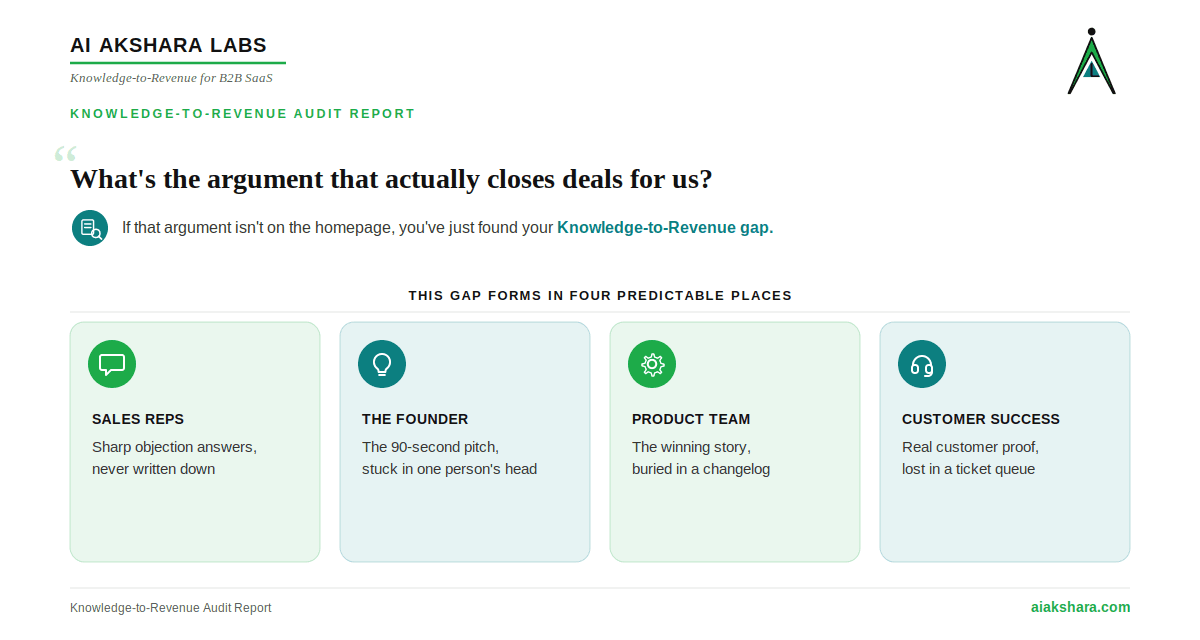
This gap forms in four predictable places.
· Your reps refine sharp answers to the same five objections every week, and none of it gets written down.
· Your founder can explain the market in ninety seconds flat, but that explanation lives only in their head.
· Your product team knows exactly why your architecture beats the competition, and it ships as a changelog entry rather than a story.
· Your Customer Success team hears proof in the customer's own words, and it dies in a ticket queue.
The numbers behind the narrative problem
TrustRadius reports, “87% of B2B buyers prefer to research independently before ever speaking with sales, and by the time they do reach out, they've narrowed their choice to two or three vendors. And per the 2024 Edelman-LinkedIn B2B Thought Leadership Impact Report, 73% of decision-makers say strong thought leadership is a more trustworthy basis for judging a company than its marketing materials. Yet only 48% rate the thought leadership they actually encounter as good.
Buyers care more about whether a company actually knows what it's talking about than how refined their page looks. However, most of what they're reading doesn't meet that bar. The real issue sits in narrative, not traffic.
When everyone optimizes for AI, no one stands out
Let us clarify with a use case.
A SaaS company holds strong product, sharp founders, and real technical depth. However, their content strategy right now involves:
· Tracking what their biggest competitors publish and creating their own version a week later.
· Mapping the keywords they want AI models to cite them, and they're pumping out comparison pages,
· Creating "Top 10 tools" listicles that help them to rank somewhere in the top three
· Writing definition posts engineered to get pulled into ChatGPT and Google's AI answers.
The output looks productive. Volume is up, the content calendar is full with SEO-focused content, and the company shows up in AI-generated results.
Now, every competitor in the category runs the same playbook. They converge on identical, interchangeable content. When a buyer, or an LLM, compares five vendors making the same optimized claims, nothing distinguishes them except price. The content budget goes toward making the company easier to commoditize. Meanwhile, the crucial differentiator for them is whether they sit idle or are lost somewhere in between.
“The founders can explain, in a single sentence on a sales call, why their architecture solves a problem the competition structurally can't. That sentence closes deals. It has never appeared in any of the published content. The pattern the CS team sees in every churned account, the objection the best AE handles in his sleep, the specific reason the happiest customer stayed.” -none of it is written down anywhere a buyer can find it.
So, they're vocal and undifferentiated in public, but silent about the exact knowledge that wins deals. They're optimizing to be found by machines while giving those machines nothing worth citing.
What you get from a K2R audit
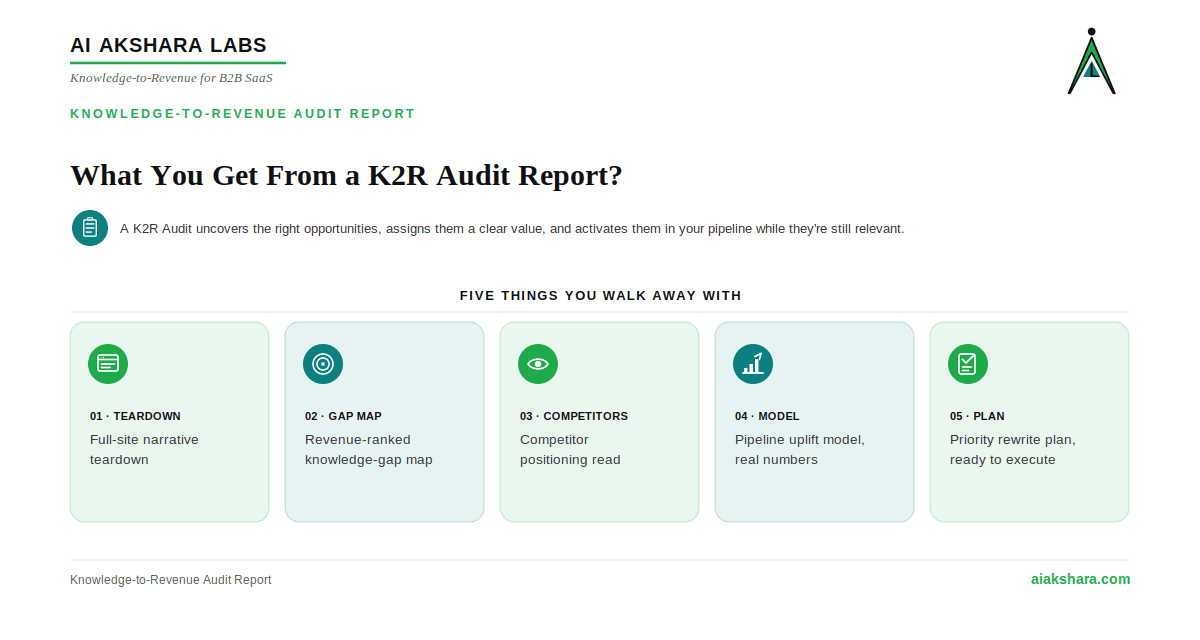
This is exactly what AI Akshara Labs’ Knowledge-to-Revenue (K2R) Audit is built to find. Rather than telling you to produce more B2B SaaS content, we run a structured, outside-in teardown of your website, sales conversations, and competitive positioning, and hand you five things:
Ø a full-site narrative teardown,
Ø a knowledge-gap map ranked by revenue impact,
Ø a competitor positioning read, a pipeline uplift model built on your real numbers,
Ø a priority rewrite plan sharp enough for any writer to execute immediately.
You leave with a scored diagnosis and a build plan.
The answer is already inside your company
Your team already has what buyers need to hear. It stays within founders’ insights, sales calls, product docs, and customer conversations, waiting to be turned into pipeline instead of staying trapped in someone's head. A K2R Audit is how you find it, price it, and put it to work before another quarter passes with your best arguments still unheard.
Apply for your K2R Audit for free to uncover the real reason for your idle pipeline.
Written by
Sayantani is a results-driven Content Strategist with over 12 years of experience in brand growth, strategic communications, and high-impact content across diverse industries. Her expertise spans content-led growth, integrated marketing communications, brand storytelling, and stakeholder engagement, with a strong ability to align communication strategies with business goals. She brings an insight-driven approach to building brands, and creating sustainable value.