Why Your LinkedIn Posts Get Likes but Never Generate Leads, and How to Fix It in 30 Days
Your LinkedIn posts earn likes from peers, not pipeline from buyers. Here's the 4-week narrative framework that fixes it.

You've been showing up. Posting three to four times a week. The likes come in, a few comments, maybe a connection request or two.
But nothing has actually changed in your business.
No one's booking calls because they saw your post. No buyer has slid into your DMs. You can't point to a single deal and say that it started on LinkedIn.
Most people I talk to assume the answer is better content. Sharper hooks, more storytelling, post at the right time. And sure, that stuff matters a little. But it's almost never the real problem.
The real problem is that you're optimizing for engagement when you should be optimizing for pipeline.
But let me tell you: you're not alone, and, more importantly, it's not a content quality problem. It's a strategic misalignment between what you're creating and what actually moves buyers in 2026.
Let's fix that.
Why engagement metrics are lying to you
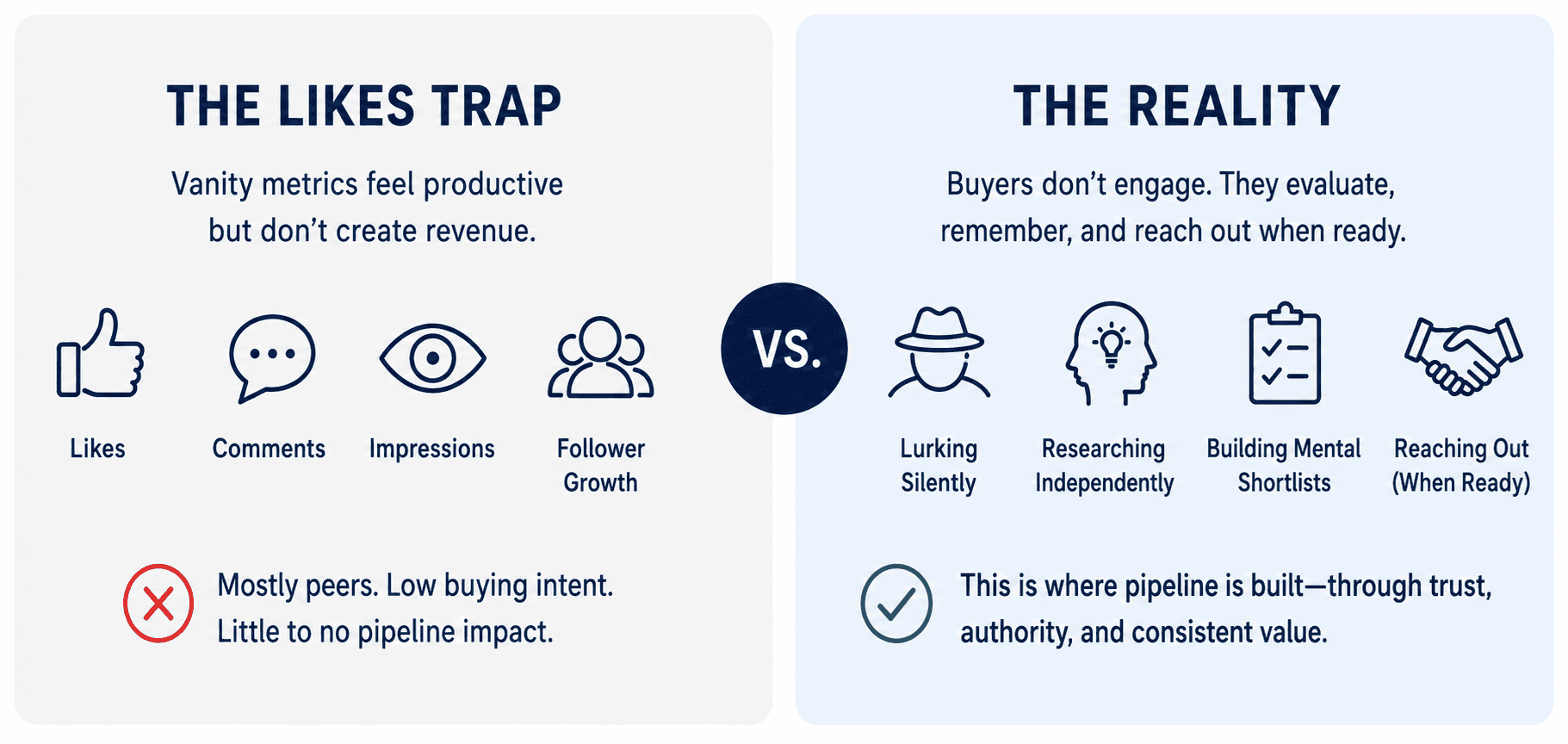
LinkedIn's native metrics are designed to make you feel productive. Impressions. Reactions. Follower growth. These are vanity indicators, useful for the algorithm, meaningless for your pipeline.
Here's the uncomfortable truth: the people liking your posts are mostly your peers, not your buyers.
Fellow founders appreciate your hot take on growth strategy. Your network claps for the company milestone post. Former colleagues engage with your career retrospective. But the VP of Operations at a 300-person manufacturing firm who is quietly trying to solve the exact problem you solve? She's reading. She's not liking. And she certainly isn't commenting.
Buyers don't announce themselves. They lurk. They evaluate. They make decisions in silence, and then they either reach out or they don't. The 2025 Edelman-LinkedIn B2B Thought Leadership Impact Report calls these people "hidden buyers", internal stakeholders who significantly influence purchases but never surface in your CRM or engage visibly with your content. Today's B2B buying journey involves anywhere from 6 to 10 stakeholders per purchase, the majority of whom prefer self-directed, digital research over ever talking to a sales rep.
And here's the number that should reframe how you think about LinkedIn entirely: at any given moment, 95% of your potential buyers are not actively in-market. They're not searching for a vendor. They're not filling out a form. They are quietly building a mental shortlist, and the founders whose thinking they've absorbed over months are the ones who make that list.
The question is: are you giving them enough of the right signal to trust you before they reach out?
Why 2026 is different: The AI commoditization shift
Here's what's changed, and it changes everything.
Content marketing is now commoditized. AI can write a "5 tips for better B2B outbound" post in four seconds. It can generate a thought-provoking hook, a structured framework, and a call-to-action that looks indistinguishable from what a seasoned marketer might produce. In fact, 94% of marketers now plan to use AI for content creation in 2026, and the share of teams who don't use AI for blog and post creation has collapsed from 65% to just 5% in two years. The volume of competent, well-structured content on LinkedIn has exploded, and buyers have developed a finely tuned filter for it.
Generic content, no matter how polished, now reads as noise.
What AI cannot replicate is your specific point of view, earned through lived experience, real failures, and pattern recognition from years in your industry. That's founder thought leadership, and in 2026, it's the last authentic differentiator you have. As one senior B2B strategist put it: "As content generation becomes commoditized, the value shifts to net-new insights grounded in real experience."
Buyers are already sensing this. A 2025 Edelman Trust Barometer survey found that only 32% of U.S. respondents say they trust AI. When buyers can't trust AI-generated content, they go looking for a human voice with a real perspective. Yours.
But there's a second shift that most founders are missing entirely: the goal of B2B thought leadership has moved from chasing organic clicks to securing AI citations.
When your buyer asks ChatGPT, Perplexity, or Claude to help them evaluate vendors, research a solution, or benchmark best practices, the AI doesn't pull from whoever has the most followers. It pulls from whoever has built the most credible, substantive, and consistently cited body of work. Consider this: 89% of B2B buyers now use generative AI during purchasing research, and AI search visitors convert at 4 to 5 times the rate of traditional organic traffic. Your LinkedIn posts, your articles, your frameworks… these are the raw material for the AI layer that now sits between you and your buyer.
If you're not building a content body that positions you as *the* authoritative source on your category, you are invisible to AI-assisted research. And AI-assisted research is how most B2B buyers now begin their evaluation process.
This is the new game. And it requires a fundamentally different content strategy.
The real problem: You're creating content, not a sales asset
Most founders approach LinkedIn the same way they'd approach a personal blog circa 2015: post interesting things, build an audience, and hope something happens.
That's not a strategy.
LinkedIn is a pipeline tool. It is the most powerful organic channel for founder-led B2B sales that has ever existed, but only if you architect your content to map directly to your sales cycle.
The data backs this up. According to the 2024 Edelman-LinkedIn B2B Thought Leadership Impact Report, 9 in 10 decision-makers say they are moderately or very likely to be more receptive to sales or marketing outreach from a company that consistently produces high-quality thought leadership. Not occasionally. Consistently. That means your content cadence is either building a permission layer for your sales team, or it isn't.

What's more, 72% of buying committees view at least three pieces of content before engaging with sales, and the average B2B buyer goes through 28 touchpoints before making a decision. Single posts don't create pipelines. Narrative arcs do.
Think about how your buyers actually move through a decision:
Awareness: They don't yet know your solution exists, or they've vaguely heard of you
Problem Recognition: They're experiencing a pain point and starting to name it
Solution Evaluation: They're researching approaches and comparing vendors
Trust Validation: They want to know if *you specifically* can be trusted to deliver
Decision: They're ready to talk, or they're not
Now ask yourself: which stage is every single one of your LinkedIn posts addressing?
If you're like most founders, the honest answer is: awareness, always. You're generating reach. You're building impressions. But you're abandoning your buyer the moment they move past casual curiosity. And 56% of B2B marketers themselves admit they struggle to connect content efforts to specific stages of the buyer journey, so you're in good company, but it's not a company worth staying in.
The fix is to stop thinking in individual posts and start thinking in narrative arcs that guide a buyer from stranger to sales conversation.
How to map posts to sales cycle stages
Here's the reframe: every piece of content you create should have a 'job'. Not "get engagement": a specific job tied to a buyer's state of mind.
Awareness-stage content earns attention. This is where provocative takes, industry observations, and contrarian perspectives live. The goal is to make someone stop scrolling and think, who is this person? Example: "The metric every SaaS CFO is tracking in 2026 that didn't exist two years ago."
Problem-recognition content names the pain your buyer is living with but hasn't articulated yet. This is the highest-value content you can create. When a buyer reads a post and thinks "this person is literally describing my situation," you have created a psychographic magnet. The 2024 Edelman-LinkedIn report found that 75% of decision-makers and C-suite executives say a single piece of thought leadership led them to research a product or service they were not previously considering. That's a pipeline door opened by a post. Example: "Why your sales team is closing deals but your retention is killing LTV and why it's not a CS problem."
Solution-evaluation content demonstrates how you think about the problem and what your approach looks like. Case study fragments, methodology breakdowns, frameworks these are the posts that get quietly saved and shared in Slack channels. Notably, 64% of B2B buyers say they favor thought leadership content over promotional material when assessing a vendor's capabilities. Show your thinking, not your features. Example: "The 3-stage diagnostic we run before recommending any infrastructure change."
Trust-validation content proves you can deliver. Client outcomes (with permission), behind-the-scenes process transparency, lessons from real failures. This is where social proof lives not as brag posts, but as honest evidence of competence. 60% of decision-makers say good thought leadership makes them willing to pay a premium for that company's services meaning your content isn't just a lead source, it's a pricing lever. Example: "We told a client to walk away from a $200K contract. Here's why, and why they came back six months later."
Decision-stage content is permission-based and explicit. This is where you make an offer, share a free resource, or open a door. Most founders over-index here; the irony is it only works when the previous four stages have been done well.
The AI citation play: Building content that outlasts the algorithm
Here's the longer game.
Every substantive piece of founder thought leadership you publish becomes a node in the AI knowledge graph of your industry. When you consistently articulate a specific point of view backed by real data, real experience, and real frameworks you create citable intellectual property. Research shows that content containing statistics sees 28–40% higher visibility in AI search results, and 44% of LLM citations come from the first 30% of a piece of text meaning strong, data-backed opening arguments are no longer just good writing practice, they're AI discoverability strategy.
The founders who will dominate B2B discovery in the next three years are the ones building a body of work, not a feed of posts. This means:
Developing named frameworks (buyers remember "the XYZ model" better than "good advice")
Publishing data from your own experience, even if the sample size is small specificity beats scale
Staking clear positions on contested questions in your industry
Cross-referencing your own ideas across posts to build a coherent intellectual narrative
There's a social proof dimension too. Reps and founders with a high Social Selling Index on LinkedIn generate 45% more opportunities and are 51% more likely to hit quota. That's not a coincidence; it's the compounding return on a body of founder thought leadership that does trust-building before the first call happens.
When a buyer (or the AI they're using) searches for answers in your category, you want your thinking to be the reference point that everything else is measured against. That's what B2B thought leadership looks like in 2026, not personal branding, not content marketing.
The 4-week LinkedIn narrative framework
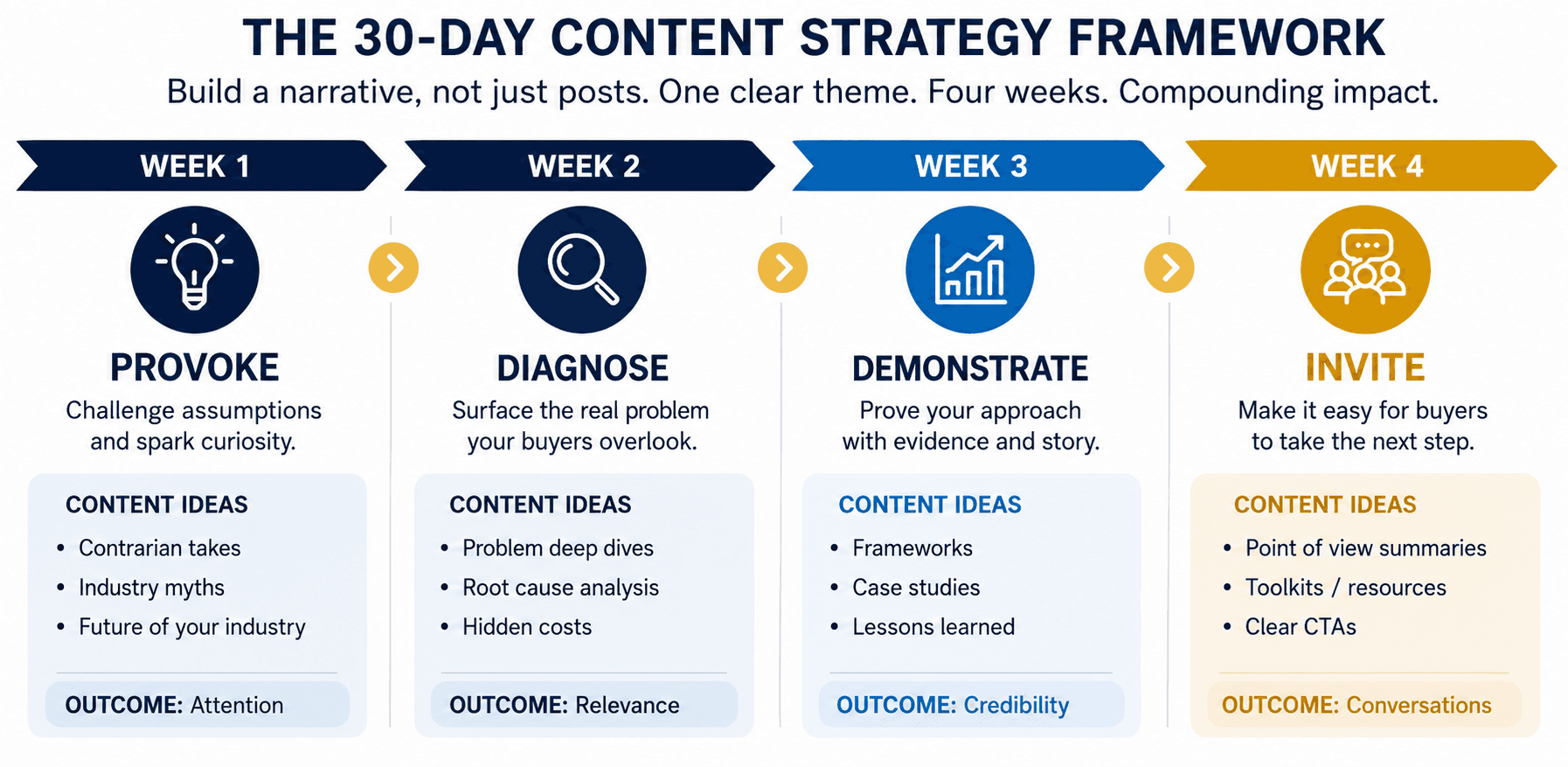
Stop posting in isolation. Here is a repeatable monthly cadence you can start this week:
Week 1: Provoke (Awareness)
Open with a pattern interrupt. Challenge a commonly held belief in your industry. Make your ICP feel seen by naming something they're experiencing, but no one is talking about. Goal: earn attention and signal category expertise.
Post format: bold observation + short "here's what I see instead" reframe
Week 2: Diagnose (Problem Recognition)
Go deep on the root cause of the problem your company solves. Not your product, the underlying problem. Use specific language your buyers use, not your internal jargon. Share a real example, even a disguised one. Goal: become the voice that names the pain best.
Post format: "Most [ICP] think the problem is X. It's actually Y. Here's how to tell the difference."
Week 3: Demonstrate (Solution Evaluation + Trust)
Show your thinking in action. Walk through a framework, a diagnostic, a decision process. This is where you reveal intellectual methodology, the *how* behind what you do. Include a real outcome where possible. Goal: demonstrate that you don't just understand the problem you have a repeatable way of solving it.
Post format: numbered framework or case narrative with a specific, honest result
Week 4: Invite (Decision + Trust Validation)
Open a door. This could be a specific offer (an audit, a teardown, a resource), a direct ask to connect, or a vulnerable post that shows the human behind the expertise. The goal here is conversion. Even one right conversation from this post justifies the month.
Post format: a clear, single CTA: "if this resonates, here's how we could help"
Repeat the cycle. The compounding effect kicks in around Month 3, when your content archive starts building trust for you before a buyer ever sends a message. And remember: 52% of decision-makers and 54% of C-suite executives already spend an hour or more each week actively reading thought leadership content. They are looking for a voice to trust. The question is whether that voice is yours.
Likes feel good. Pipeline pays the bills.
Choose accordingly.
If you're ready to make that shift, this is exactly what we work on at AI Akshara Labs: turning your LinkedIn presence into something your pipeline can actually feel. See how it works.
Written by
Sayantani is a results-driven Content Strategist with over 12 years of experience in brand growth, strategic communications, and high-impact content across diverse industries. Her expertise spans content-led growth, integrated marketing communications, brand storytelling, and stakeholder engagement, with a strong ability to align communication strategies with business goals. She brings an insight-driven approach to building brands, and creating sustainable value.