Why SaaS Content Doesn’t Convert: It’s a Narrative Problem
69% of B2B marketers are under pressure to produce more content. But volume isn't the problem. Weak narrative is. Find out what's actually costing you pipeline.

In the last 12 months, you have published 47 blog posts. Your LinkedIn posts go out three times a week. Your team repurposes everything into carousels, newsletters, and Twitter threads. You have a content calendar, a Notion doc full of briefs, and a freelancer who delivers on time.
And your pipeline hasn't moved.
If this sounds familiar, you are neither alone nor lazy. You are simply solving the wrong problem.
The natural instinct when content isn't working is to produce more of it. More formats, more frequency, more channels. But the issue almost never lives in the volume. It lives upstream, in the story that runs through all of it, or more often, the story that doesn't.
You don't have a content problem. You have a narrative problem.
The busy content trap
In 2025, Adobe surveyed B2B practitioners across industries and found something that should stop every SaaS founder in their tracks. Despite buyers already being overwhelmed with content, 69% of marketing practitioners said they felt pressured to rapidly increase both the number and variety of digital assets they produce. Meanwhile, only 36% were focused on optimizing that content for relevance and conversion.
The finding was blunt: "B2B buyers don't need more content. What they need is content that's more relevant and timely to help them navigate complex purchase decisions." (Adobe AI and Digital Trends in B2B Journeys, 2025)
Most SaaS companies responded to that finding by… creating more content.
This is the busy content trap. You optimize for output when what your pipeline needs is clarity.
What is narrative, and why do most teams skip it
The word "narrative" gets thrown around a lot in marketing. It's worth being specific about what it means and what happens when it's missing.
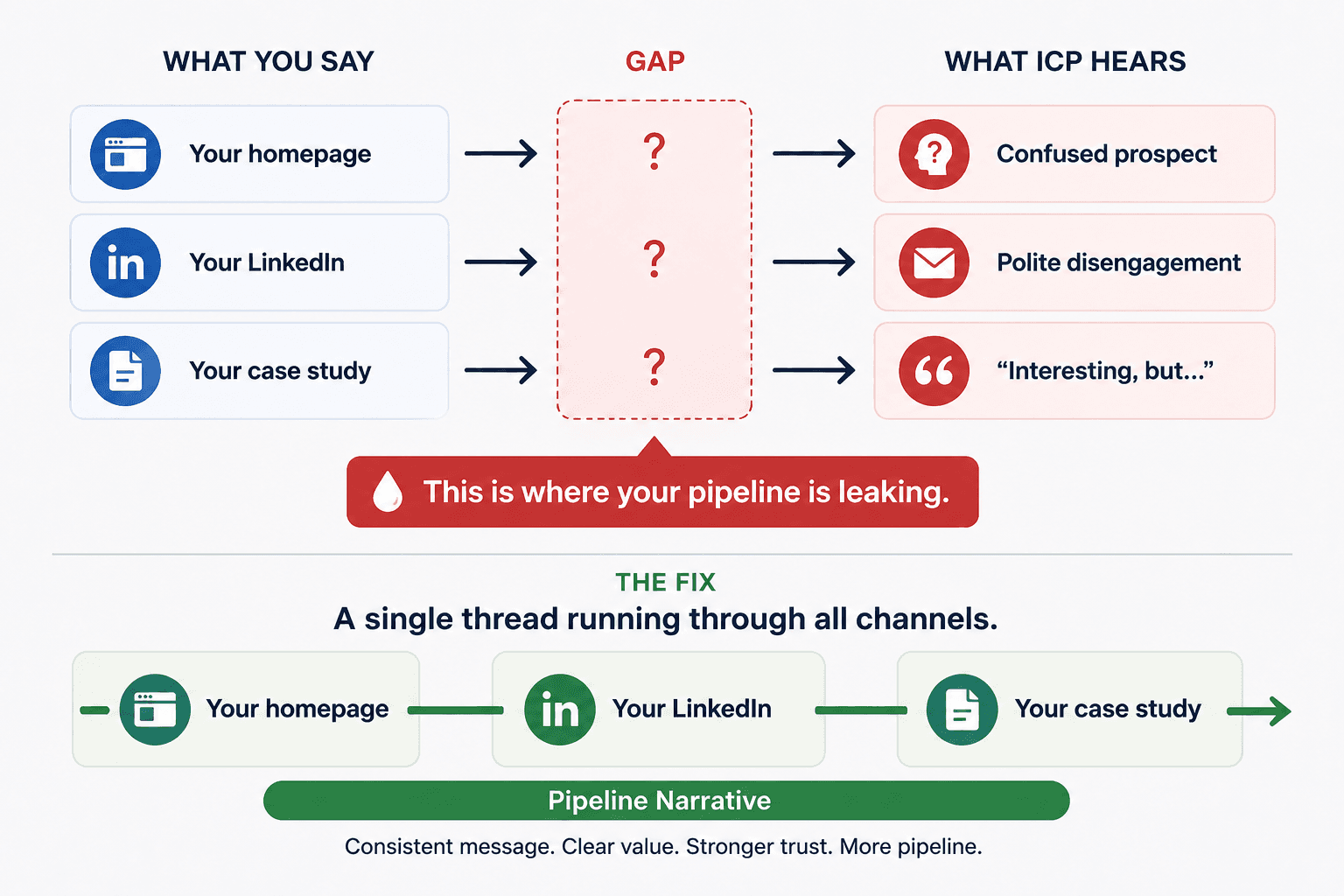
Your narrative is the single coherent story that connects your ICP's pain to your product's value, consistently, across every piece of content you produce. It's the thread that runs from your homepage headline through your founder's LinkedIn posts through your case studies through your outbound email sequences.
When it's present, a prospect can encounter your brand in three different places and hear the same clear story each time. When it's absent, they encounter three slightly different versions of what you do, and none of them are specific enough to feel like they were written for that person.
Diane Wiredu, a B2B SaaS messaging strategist and founder of Lion Words, put it plainly at the Exit Five Drive conference in 2025:
"We have a little bit of a messaging problem in B2B marketing. For years, the advice has been: be clear, show the value, be compelling. The magic trifecta. And all of you did it. And it didn't work. Because everyone did it."
This is the core of the problem. The execution advice: be clear, be consistent, be compelling, is correct. But it assumes you have something to be clear and consistent about. If the underlying narrative is weak, executing it well just makes the weakness more visible.
The pattern that shows up in every stalled pipeline
I have worked with B2B SaaS companies at various stages, and the same pattern appears reliably.
The product is genuinely good. The team is smart. The founders are credible. But somewhere between the product and the pipeline, something is being lost in translation.
April Dunford, one of the foremost positioning experts for B2B tech companies and author of Obviously Awesome, describes this pattern from her years as a startup executive:
"If your product isn't doing well, there's a chance that it may not be the product that's the problem. It may be your positioning. Weak positioning hurts you in the early stages of the pipeline. If our positioning doesn't resonate for that champion, we're dead in the water. We don't even get on a short list." (Lenny's Podcast, 2024)
Dunford goes further: she estimates that weak positioning costs B2B companies nearly 40% of their pipeline opportunities, not through bad sales execution, but through confusion that happens before a prospect ever picks up the phone.
That number deserves to sit with you for a moment. Forty percent of your potential pipeline isn't being lost because your sales team isn't skilled enough, your pricing is wrong, or your product has gaps. It is being lost because the story around your product isn't sharp enough to get you on the shortlist.
The three symptoms of a narrative problem
Here is how to know if this is your issue. These are the three symptoms that show up most consistently.
1. Your content gets engagement but not inquiries
Likes, comments, and shares are the metrics that feel good but don't move the needle. Your ICP might even be in the audience. But the content isn't moving them because it isn't connected to a commercial outcome. It's thought leadership in the classical sense: people think you're smart, but they don't know what to do next.
2. Your sales team isn't using your content.
If you have to convince your AEs to share your content with prospects, that is a signal. Content that is genuinely tied to deal stages and ICP objections gets used without prompting. Sales teams share things that make their conversations easier. If they're not sharing yours, the content isn't doing that job.
3. Everyone on your team describes the product slightly differently.
Ask your founder, head of sales, marketing lead, and SDR to each send you a one-line description of what the company does. If you get four different answers (and you will!), you don't have a narrative. You have four independent interpretations of one. Every piece of content produced from that ambiguity will say something slightly different to every prospect who encounters it.
Wiredu, speaking on the Grow Your B2B SaaS podcast in 2024, described this as the "sea of sameness", the state where every SaaS company in a category sounds identical because they're all executing the same clarity advice without a distinct underlying point of view:
"Too many companies get it wrong. Messaging can make or break your ability to attract, convert, and retain customers. People within a company often can't see the wood for the trees. They know too much and don't understand how complex their messaging has become."
Why producing more content makes this worse
Here is the counterintuitive part that most content advice gets wrong.
When your narrative is unclear, producing more content doesn't dilute the problem. It amplifies it. Every additional blog post, LinkedIn carousel, or email nurture sequence adds another data point for your prospect to triangulate, and if the underlying message is inconsistent, the triangulation leaves them more confused.
There is also a compounding trust problem. When a prospect encounters your brand multiple times and hears a different story each time, they don't conclude that you have a lot to say. Instead, they conclude that you don't quite know what you are. That conclusion, usually made in seconds, below the level of conscious thought, is what kills demos before they're requested.
The research reinforces this. The same Adobe study found that in 2025, just 30% of B2B organizations prioritized performance insights, such as A/B testing, to understand which content was actually working. The other 70% were producing content and hoping. Without knowing which narrative is resonating, you have no basis for improving it, but only for producing more of it.
What fixing the narrative actually looks like
Narrative work is not a rebrand. It is not a new tagline or website refresh.
It is a deliberate process of connecting three things that most SaaS companies treat as separate: your ICP's exact language for their problem, your product's specific mechanism for solving it, and the proof that it has worked for someone exactly like them.
When those three things are connected and consistent across every piece of content you produce, something shifts. Prospects read your landing page and think: this was written about me. They come across your founder's LinkedIn post and think: "This person understands my world." They read your case study and think: that's exactly our situation.
That recognition, which is more like a visceral sense of being understood, is what triggers a demo request. Not a clever headline, or a well-structured blog post. It is the feeling of being seen by someone who gets it.
April Dunford has described what good positioning feels like when it's working:
"When it's working really well, it feels like magic and really great positioning feels obvious."
The word "obvious" is the telltale. When your narrative is right, your ICP should read your homepage and think: of course this is for me. Everything is obvious. The problem, the solution, the proof. None of it requires effort to understand.
If your prospects are working hard to understand what you do and why it matters to them, the narrative isn't there yet.
The one question that diagnoses everything
Here is the single diagnostic question that cuts through all the noise:
If your best current customer were describing your product to a colleague who has the same problem they had, what would they say?
That answer, if you can get it, is your narrative. It is the language of someone already convinced, describing its value to someone who isn't. It is more useful than any brand workshop, positioning exercise, or messaging framework you will ever complete.
Most SaaS companies have never asked this question. Or they've asked it but never used the answer to write their homepage, structure their LinkedIn posts, or brief their freelancers.
That gap between what the convinced customers say and what marketing materials say is where the pipeline is being lost.
What to do this week
You don't need to rebuild everything at once. Here are three things that will give you clarity quickly.
Talk to three customers. Not a formal interview, though. Just a genuine conversation. Ask them to describe what they tell colleagues about your product. Record it. Transcribe it. The language in that transcript is more valuable than anything a copywriter will produce from a brief.
Audit your homepage against your sales calls. Read your homepage out loud, then listen back to three recent sales call recordings. Notice where the language diverges. The sales calls contain the real narrative… the one that's actually working in the room. Your homepage probably contains a more polished, less effective version of it.
Pick one ICP and write one piece of content that speaks only to them. Not your whole market or three segments. One specific person with one specific problem in one specific situation. Make it so specific that someone outside that profile would feel excluded. Then watch what happens to engagement from the people inside it.
The bottom line
Content is not the problem. Your narrative is.
The SaaS companies filling their pipeline are not the ones producing the most content. They are the ones whose content, however much or little of it exists, tells the same clear story every time a prospect encounters it. A story specific enough to feel personal. A story that connects their exact pain to a specific mechanism to prove they can believe.
That story (if you have it!) makes every piece of content you produce more effective. If you don't have it, no amount of production will fill the gap.
The question is not: how do we make more content?
The question is: what is the story we are trying to tell, and are we telling it consistently?
About AI Akshara Labs
We build pipeline narrative for B2B SaaS companies… the content strategy that connects your ICP's pain to your product's value, consistently across every channel. If your content is busy but your pipeline isn't moving, book a free 30-minute messaging audit.
References:
Adobe AI and Digital Trends in B2B Journeys, 2025
April Dunford on Lenny's Podcast: "How to Nail Your Product Positioning," 2024
Diane Wiredu at Exit Five Drive Conference, 2025
Diane Wiredu on Grow Your B2B SaaS Podcast, Season 5 Episode 8, 2024
April Dunford, Obviously Awesome (2026 updated edition)

